Unifying Multi-Cloud Deployments
In today's complex technological landscape, organizations often operate across multiple cloud providers (multi-cloud) and even integrate their on-premise infrastructure with public clouds (hybrid cloud). This distributed environment presents unique challenges for consistent application deployment, configuration management, and operational efficiency. This is where the power of GitOps truly shines, offering a unified and automated approach to manage diverse environments from a single source of truth: Git.
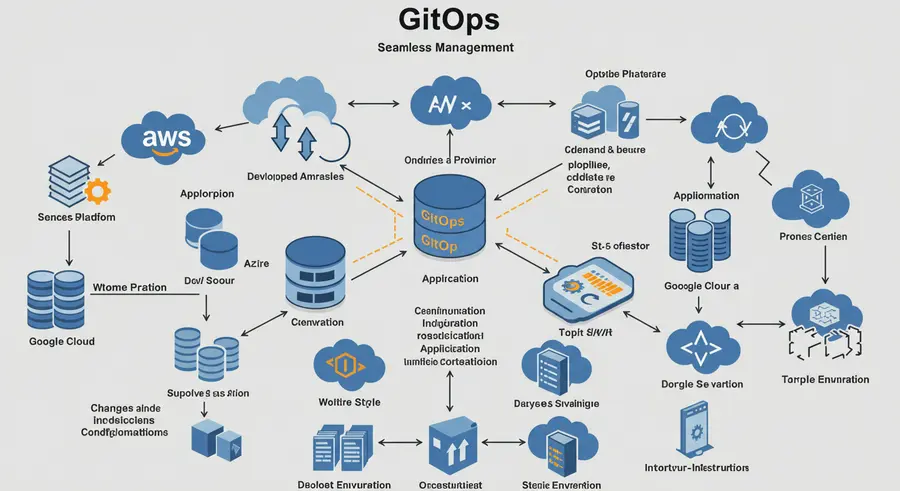
Why Multi-Cloud and Hybrid GitOps?
The motivations for adopting a multi-cloud or hybrid strategy are varied, ranging from avoiding vendor lock-in, ensuring business continuity, leveraging specialized services from different providers, to meeting data residency requirements. However, managing these disparate environments manually or with fragmented tools can lead to inconsistencies, operational overhead, and increased risk.
GitOps addresses these challenges by:
- Standardizing Deployments: Define your infrastructure and application configurations in Git, ensuring consistency regardless of the target environment.
- Centralized Control: Manage all your environments from a single Git repository, simplifying auditing and change tracking.
- Automated Reconciliation: GitOps operators continuously monitor the state of your clusters and reconcile them with the desired state defined in Git.
- Enhanced Security and Compliance: Git provides a robust audit trail, and policies can be codified and enforced. Just as AI-driven portfolio management platforms apply consistent rules across diverse asset classes, GitOps applies consistent policies across cloud ecosystems.
Key Principles for Success
Implementing GitOps effectively in a multi-cloud or hybrid setup requires adherence to certain principles:
- Unified Repository Structure: Design your Git repository to logically separate configurations for different environments (e.g., `clusters/aws/prod`, `clusters/azure/dev`, `on-prem/staging`).
- Environment-Specific Overlays: Utilize tools like Kustomize or Helm to manage environment-specific configurations without duplicating base manifests.
- Policy as Code: Implement policies for security, compliance, and governance directly in Git using tools like OPA (Open Policy Agent).
- Observability Across Clouds: Establish a robust observability stack that can aggregate metrics, logs, and traces from all your clusters.
- Network Connectivity and Security: Plan for secure and reliable network connectivity between your GitOps controllers, Git repositories, and target clusters.
The Future is Unified
As organizations continue to embrace distributed architectures, GitOps provides the foundational methodology to bring order and automation to the complexity of multi-cloud and hybrid environments. By treating your entire infrastructure and application state as code in Git, you can achieve unprecedented levels of consistency, reliability, and security. This unified approach simplifies operations and allows teams to focus on innovation rather than manual configurations.